▍ record · seq=0001 · type=meta
Memory that
outlives the
context window.
Agents rarely carry what you taught them from one session into the next — so you re-establish context by hand, every time, and pay for it in tokens. AegisDB keeps that knowledge outside the window and feeds back only what's relevant, per prompt.
▍ record · seq=0002 · type=semantic
Why not Redis, SQLite, or a vector store?
You almost certainly run a database already, and you can absolutely build an agent memory layer on Postgres and pgvector — plenty of teams have.
What you end up writing is everything the database doesn't give you: the distinction between an event and a fact that gets corrected, the expiry rules, the supersession rules, the ranking, the graph traversal, the per-prompt recall budget. AegisDB is that layer already built and benchmarked, in one binary that speaks a line of JSON.
what you still have to build
redis      → fast, but evicts on its own TTL
sqlite     → durable rows, no recall by meaning
pgvector   → similarity; events, expiry, graph are yours
aegisdb    → events, facts, working + a graph, each lifecycled
▍ record · seq=0003 · type=semantic
Fewer tokens spent re-teaching the model.
Pasted-in context is billed again on every turn it stays in the window. AegisDB holds it outside the prompt and injects a ranked slice per request, so the window carries the task instead of the backstory.
- Recall, don't re-explain — your stack, conventions, and past decisions are already known, so you stop re-pasting them each session.
- A relevant slice, not a dump — each prompt pulls only the top-ranked memories — ranked by similarity × importance — instead of replaying entire transcripts; the model never sees the rest.
- Short sessions, full knowledge — start fresh instead of dragging a giant transcript whose every turn re-bills the whole context.
- Distilled & shared — capture stores salient outcomes, not raw logs, and a team reuses context established once.
▍ record · seq=0004 · type=semantic
Three kinds of memory, three lifecycles.
Episodic records are immutable, semantic facts are updatable, working memory expires on a TTL. Persisted memories are durable by default; give one a deadline and it auto-archives instead.
Episodic events
Append-only records of what happened. Written once, never rewritten — the source of truth every index is rebuilt from.
Semantic facts
Updatable knowledge where the latest version wins. Correct a fact and the old one steps aside, no duplicates left behind.
Working memory
A per-session ring buffer with a TTL. Keep scratch context close, then promote what proves worth keeping.
Recall, five ways
Search by vector similarity, by keyword, by tags (all/any), by time range, or by the fact a record asserts — each on a purpose-built index, not a scan.
Vector search that scales
Exact cosine while a set is small; past a threshold it switches to an HNSW graph for sublinear approximate-nearest-neighbour search. The graph is checkpointed — a restart reloads it instead of rebuilding — and vectors can be int8-quantized to cut its memory ~4×.
Keywords, for the things vectors miss
Embeddings average rare tokens away, so --tenant-max-records or hnsw.c:214 can be unfindable by the exact string you remember. A BM25 index keeps identifiers intact and finds them verbatim. Send a keyword and a vector together and the two result lists are fused by reciprocal rank — exact matches and topical ones both surface. No embedding provider configured? Keyword search still works.
A graph of context
Link memories with typed, directed edges and walk them breadth-first to pull in what's related to what you just recalled. Follow only the edge kinds you asked for, forwards or backwards — "what supersedes this?" and "what depends on this?" are one call each, not a scan — and every hit reports the hop that reached it, so a walk reads as a path.
Production hardening
- Crash-safe log — magic + CRC frames; a torn tail is trimmed and interior bit-rot skipped, so one bad record doesn't cost you the log.
- Tunable durability — sync/batch/interval fsync; checkpoint + non-blocking compaction recovery.
- Encryption at rest — optional XChaCha20-Poly1305 over the log + checkpoints (vendored, no deps), with an offline migrator.
- Read replicas — async log-shipping standbys for read scaling and manual failover.
Also: multi-tenant namespace + scope tokens, per-tenant quotas and rate limits, online backup/restore, and a soft index-RAM cap that backpressures rather than getting OOM-killed. Full reference in the README & docs.
▍ record · seq=0005 · type=semantic
Keeping the corpus from becoming noise.
A store that only grows gets harder to retrieve from. AegisDB collapses near-duplicates, ages out low-value records, and lets a new fact supersede the one it contradicts — and any recall can print the arithmetic behind its ranking.
Dedup with a paper trail
consolidate merges near-duplicate facts into one survivor and records a supersedes link to each record it absorbs — an auditable merge, not silent loss.
Decay, not hoarding
forget ages out low-value records by importance × recency, so a long-running corpus — and its RAM — plateaus instead of growing without bound.
Contradictions resolve
When capture learns a fact that updates an old one, the new version supersedes it — "prefers X, not Y" — instead of stacking both.
Explainable recall
Ask search to explain and every hit returns its ranking breakdown — relevance × weight × recency = score, plus which path found it — so you can see why a memory surfaced, or why it didn't.
Prove it, don't guess
make eval scores recall@k / MRR against a labelled corpus — the dedup and decay policies, and keyword vs vector vs fused retrieval — so a memory-quality change is gated on numbers, not vibes.
▍ record · seq=0006 · type=semantic
Answers that live in no single memory.
Retrieval can only hand back a record that already contains the answer. So a memory can carry a machine-readable fact — {s, p, o} — beside its sentence, and the server draws the conclusions those facts entail, links each one to the premises it rests on, and withdraws it when a premise goes away.
It is a small set of declared rules, not a reasoner: no rule language, no query dialect, and no model anywhere in the loop — so every step is reproducible and regression-tested. All of it is opt-in and off by default, recall never depends on it, and a deployment that writes no facts is byte-for-byte unchanged on disk and on the wire.
A fact beside the sentence
insert takes an optional fact: {s, p, o} next to the prose, and search / count take a pattern — {"s": 42, "p": "prefers", "o": "*"} — answered from an index, not a scan. A --predicate-registry declares the vocabulary, and a fact naming an undeclared predicate is refused at insert rather than quietly stored.
Conclusions, drawn off the write path
--inference materializes the transitive, symmetric and inverse-of closures the registry declares — on a background tick, per namespace, depth- and fanout-capped. A write never waits on it, a replica never runs it, and its cost is reported in stats like every other index.
Retract a premise, lose the conclusion
A derived record names the rule that fired and the premises it stands on — as a set of independent justifications, because a conclusion can have more than one route. Delete a premise and the conclusion is withdrawn once every route has lost one. Nothing is left standing on a fact you deleted.
“Why do you believe this?”
explain already prints why a memory ranked. On a derived one it also returns a derivation — rule, depth, premise ids — so a belief is a tree you can walk. It is written server-side and a client cannot manufacture one. Ask, and a model will read that tree back to you in English; it never produces the proof, only renders one you can check.
Contradictions surface, not resolve
Two live values for a single-valued predicate, or a pair the registry marks mutually exclusive, raise a conflicts_with edge and a counter — caught deterministically, with no model call. AegisDB reports the conflict rather than silently picking a winner.
Prose in, symbols out
Capture can distil a transcript into triples, prompted against the registry as a controlled vocabulary, resolving each mention to an existing entity by cosine + BM25 before minting a new one. A triple that doesn't fit is dropped and counted, never bent onto the nearest predicate — and nothing is lost by that, because the prose stays in the record and stays searchable.
Measured, not asserted: make eval-multihop scores a question set whose answers live in no single record — the symbolic path answers 100% at recall@5 where semantic, keyword and fused retrieval each score 0%. The gate bounds retrieval as well, which is what caught a first draft of the dataset answering half its own questions by word overlap. Design notes: the graph, typed facts, inference & the model seam.
▍ record · seq=0007 · type=meta
Yours to inspect, replay, and erase.
It's your data on your box — so you can see all of it, reconstruct any past state, and truly delete it. No console, no support ticket, no export request.
Browse it in a UI
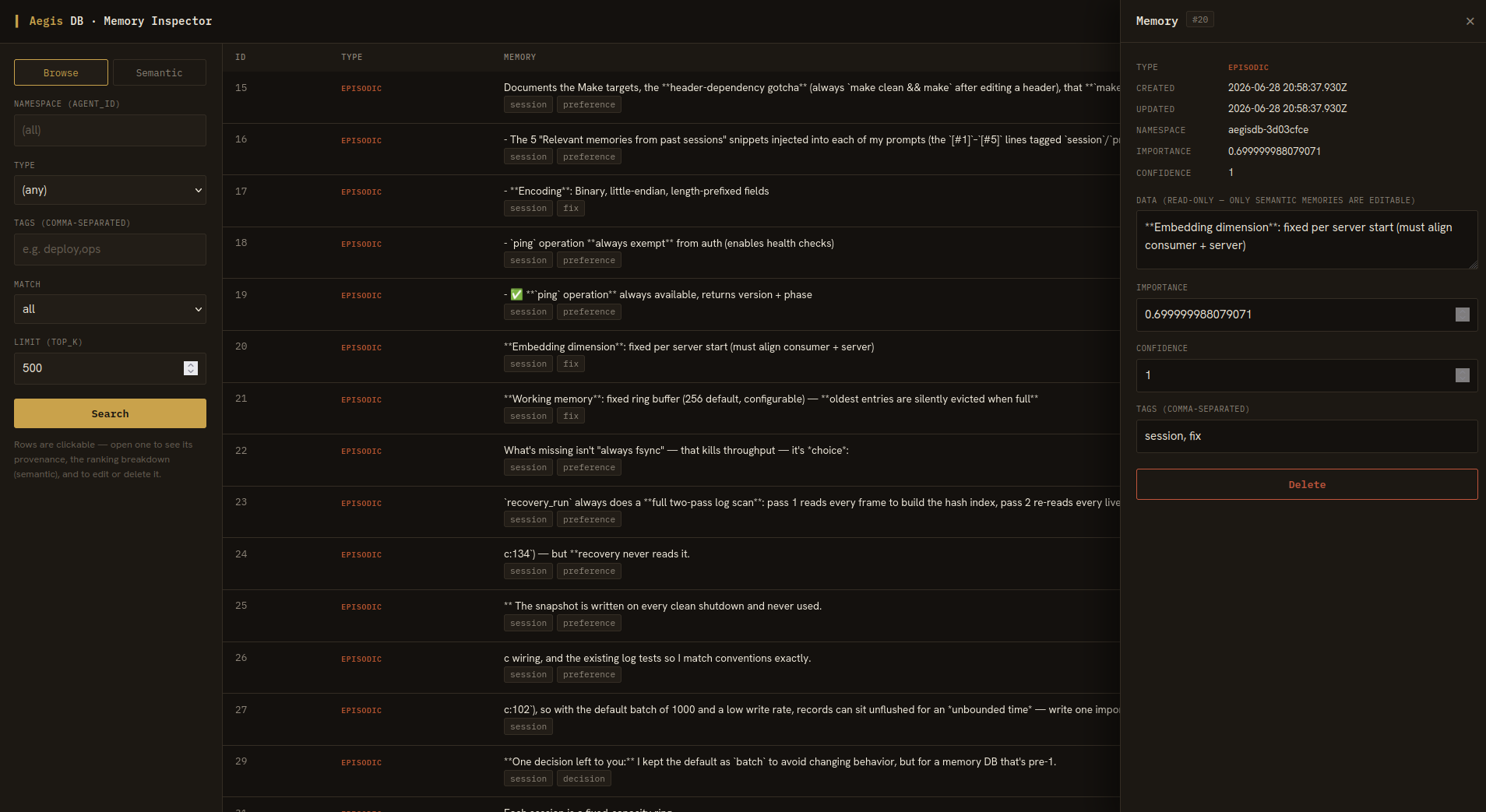
A local memory inspector: search records, see why each hit ranked, and edit or delete one by hand. docker compose --profile inspector up.
Replay any past state
history returns every version of a record with validity intervals; get with as_of reconstructs it as of any past moment — what did the agent know at T?
Right to be forgotten
export dumps everything stored about a subject; purge hard-deletes a namespace and compacts, so the bytes actually leave the on-disk log.
▍ record · seq=0008 · type=semantic
Fast enough to be invisible.
Recall sits in the agent's inner loop, so latency is the whole game. Vector search stays sub-millisecond at 100k memories, and recall@10 holds at 1.00 on the bench corpus.
These are AegisDB's own numbers, not a comparison — and you can reproduce them yourself: make bench (vector recall + latency) and make wire-bench (end-to-end over TCP).
make bench · make wire-bench
vector recall  → 0.14 ms @ 10k · 0.22 ms @ 100k
recall@10      → 1.00  (384-dim, HNSW)
ping           → 158k ops/s · p50 0.05 ms
read (get)     → p50 0.8 ms over the wire

Intel Core i7-1355U · loopback · single node
▍ record · seq=0009 · type=semantic
Does the memory actually work? Run the benchmark.
Memory only earns its tokens if it changes outcomes, so the benchmark ships with the code. make eval-tasks is a controlled A/B: each task teaches a fact in one session, then asks about it in a fresh session — once with recall, once without. Each task runs in its own namespace, and --sandbox runs the no-memory arm from an empty directory so it can't recover the answer from your repo.
On the bundled 10-task suite the recorded run is 100% with memory, 0% without. The facts are fictional and unguessable, so that 0% is the no-memory arm correctly answering "I don't know" — the number measures the harness's isolation as much as memory's lift. Point it at your own tasks or a different answer model and expect a smaller, more interesting gap. make eval separately gates retrieval quality (recall@k / MRR) so scoring changes can't regress silently.
recorded run · 10 coding-agent tasks
$ make eval-tasks EVAL_ARGS='--model claude-code --sandbox'
with memory (ON)     → 100%
without memory (OFF) →   0%   answers "I don't know"
lift                 → +100%  10 tasks

$ make eval
recall quality       → recall@k / MRR gate
▍ record · seq=0010 · type=semantic
One JSON line in. One JSON line back.
The wire protocol is newline-delimited JSON over TCP. No SDK, no driver — any language that can open a socket can speak it.
store a memory, then recall it
# write an episodic memory
{"operation":"insert", "type":"episodic", "tags":["user"], "data":"Prefers dark mode"}
→ {"ok":true, "record":{"id":1, "type":"episodic"}}

# recall it by tag
{"operation":"search", "tags":["user"], "top_k":5}
→ {"ok":true, "total":1, "records":[ … ]}

# or by keyword — add "embedding" too and the two are fused
{"operation":"search", "query":"dark mode", "top_k":5}
→ {"ok":true, "total":1, "records":[ … ]}
operations · ping insert get update delete search count promote relate traverse stats
insert takes a batch of records in one call; delete and count work by id or by filter (tags / type / time range).
stats reports durability lag, live & tombstone counts, log size, and per-index sizes — for monitoring and capacity planning.
▍ record · seq=0011 · type=semantic
Long-term memory for Claude Code.
An MCP server plus session hooks: relevant memories are recalled into context on every prompt, and the ones worth keeping are captured when the session ends.
- Automatic recall on each prompt, inside a strict time budget.
- Automatic capture at session end, filtered by salience.
- Per-project namespaces — isolated by default, shared by choice.
- No clone — uvx fetches the published package (aegisdb-mcp on PyPI) on demand.
- One-command setup — uvx --from aegisdb-mcp aegisdb-init writes the config below and the hooks; or install the /aegis-setup skill and let Claude do it.
- Fails open — if the backend is down, your session keeps working.
.mcp.json — scaffolded by aegisdb-init
{
  "mcpServers": {
    "memory": {
      "command": "uvx",
      "args": ["aegisdb-mcp"],
      "env": {
        "AEGIS_NAMESPACE": "my-project",
        "AEGIS_EMBEDDING_DIMENSIONS": "1024"
      }
    }
  }
}
▍ record · seq=0012 · type=semantic
One agent learns it. Everyone's agent knows it.
Every developer on a team re-teaches their agent the same things — why the middleware is bypassed in staging, which migration approach was rejected last quarter and why, the gotcha that costs an hour if you miss it. That knowledge dies at the end of each session, per person, and the next agent re-derives it from scratch.
Point the team at one server with a token in a shared namespace, and a decision captured on Tuesday is recalled into someone else's session on Thursday — ranked and budgeted, a slice rather than a dump. A new hire's agent starts on day one already knowing the conventions and the shape of the system.
Self-hosting is load-bearing here, not a preference. The memories a coding agent accumulates are your internal engineering knowledge — architecture rationale, security posture, incident history, unreleased plans. That is the category you can't hand to a third-party SaaS, which is why this is a binary you run, on your box, with a key only you hold.
- Isolated tenants, or one shared pool — a namespace per person or per client project, enforced by the server; quotas and rate limits keep one runaway agent from filling the disk or monopolizing the box.
- Auditable, not a black box — explain shows why a memory ranked, as_of replays what the agent knew at T, and export / purge answer "erase everything about X".
- Read-only tokens for automation — CI, a review bot, or a docs generator reads team memory without writing to it.
- Set up in three commands — mint a token, run the server, drop in a .mcp.json. The recipe is below ↓
Where it doesn't pay off: if you use Claude Code occasionally, a CLAUDE.md checked into the repo does most of this for free. Shared memory earns its keep once the knowledge is too large, too per-developer, or too fast-moving to hand-maintain in a file — and a shared pool wants a little hygiene (consolidate, forget) so it doesn't silt up.
▍ record · seq=0013 · type=episodic
Run it, talk to it.
Pull the image or build from source — either way you're holding a connection in seconds.
Run it — prebuilt multi-arch image, no toolchain
docker run -d --name aegisdb -p 9470:9470 -v aegis-data:/data ghcr.io/d4n-larsson/aegisdb:latest
…or build from source
git clone https://github.com/d4n-larsson/aegisdb && cd aegisdb && make
./build/aegisdb --data-dir ./data --port 9470
Talk to it — the binary is also the client
docker exec aegisdb aegisdb client put --tags user "prefers dark mode"
docker exec aegisdb aegisdb client search --tags user
Read the reference
The wire-protocol reference and quickstart cover every operation.
▍ record · seq=0014 · type=meta
Set up shared memory for a team.
One server, one tenant token per project, and Claude Code wired in with uvx — no clone anywhere. Uses the published image and the aegisdb-mcp PyPI package.
Mint a tenant token
docker run --rm ghcr.io/d4n-larsson/aegisdb \
  gen-token --namespace my-project --scope rw
Prints a hashed token-file line and the one-time token. Append the line to tokens.txt; keep the token for step 3.
Run the server — authenticated, durable
docker run -d --name aegisdb -p 9470:9470 \
  -v aegis-data:/data -v "$PWD/tokens.txt:/tokens.txt:ro" \
  ghcr.io/d4n-larsson/aegisdb:latest \
  --data-dir /data --embedding-dim 1024 --auth-token-file /tokens.txt
Tokens travel in plaintext — keep the port on a private network or behind a TLS-terminating proxy. For a shared box, add --encryption-key-file (see gen-key) to encrypt the data volume at rest.
Point Claude Code at it — .mcp.json
{
  "mcpServers": {
    "memory": {
      "command": "uvx",
      "args": ["aegisdb-mcp"],
      "env": {
        "AEGIS_HOST": "memory.internal",
        "AEGIS_PORT": "9470",
        "AEGIS_AUTH_TOKEN": "<token from step 1>",
        "AEGIS_EMBEDDING_DIMENSIONS": "1024"
      }
    }
  }
}
The token's namespace is authoritative — no AEGIS_NAMESPACE needed. uvx fetches the package on demand (install uv once). Or skip the hand-editing entirely — uvx --from aegisdb-mcp aegisdb-init --host memory.internal --auth-token <token> writes this file and the recall/capture hooks.
A teammate repeats step 1 for their own token — their own --namespace to stay isolated, a shared one to pool memory — then step 3. No clone, no build. The team server tutorial covers the hook config, quotas, encryption at rest, backups & troubleshooting.